Showing posts with label Rules:Empire. Show all posts

Thursday, 1 August 2013

Russian Jaeger - 1812+

Russian Jaegers (1812+)


I better get this thing Napoleonic before we get way off track.

Here is a quick one then - some 1812 Russian Jaeger Battalions.


Monday, 16 July 2012

French Division - 1813

Tour de France - Stage 14

Great stage race last night with huge amounts of drama ... sabotage on the course, killer hill climbs at 18%, death defying descents down wet slopes, chaos, drama, and sportsmanship.  Wiggo is a true British champion !

Good stage to pull out some masses now and look at a Division on the table, all based up on battalion sabot bases.

Here is what an 1813 Division roughly looks like at 1:60 scale.  This is modelled on the French 6th Division / II Corps on the Southern front at Leipzig in 1813.


Lucky for me ... the French units are quite 'understrength' for this campaign.

The leading brigade - 3 battalions of Legere with 3 battalions of ligne in the 2nd wave.  3 Battalions in column of divisions on each flank, and 2 batteries in the centre.

Note the lack of cavalry at the Division level.  Not much more at Corps level for this unit either.


Saturday, 14 July 2012

Friday, 13 July 2012

French Line Grenadiers

Tour de France - Stage 11

Finished off some French Line Grenadier companies, as I watched the race unfold through the mountains for France last night


Sunday, 8 July 2012

French Ligne in Greatcoats - 1813+

Tour de France - Stage 7


What a great nights viewing last night ... spectacular scenery into the Vosges mountains.

Took a few shortcuts myself, and finished off a single battalion of French line in Greatcoats.


The first real climbs of the Tour saw the real contenders come to the front and fight it out for the last 6km all uphill.

This last section is at 20% slope ... ouch !


Saturday, 7 July 2012

French Dragoons

Tour de France Peter Sagan - Stage 6


Bit of crazy carnage last night in stage 6 on the road to Metz .. it was a bit like watching live coverage of Borodino !

At the end though ... somehow .. Peter Sagan held it all together to jump just at the right moment, and power over the top of Greipel.

Amazing effort. Im stunned.


Friday, 6 July 2012

Grand Duchy of Warsaw - 1st Regiment

Tour de France - Stage 5


Finishing off the next Polish regiment in the line ..  2 more battalions of Polish line infantry.


So as far as Leipzig goes, we have the VIII Polish) Corps, 26th Division, 1st Brigade.

OOB for this brigade is :

- Vistula Legion light infantry - 2 Bns at around 400 men each.
- 1st Polish Line Regiment - 2 Bns at around 400 men each.
- 16th Polish Line Regiment - 2 Bns at around 400 men each.


Thursday, 5 July 2012

Vistula Legion - Leipzig 1813

Tour de France - Stage 4


Continuing on with the painting challenge, I was struggling to get a bit finished last night.

Quite appropriate, as the high pace of the race so far so many riders struggling to hold their line and stay out of trouble at the front of the peleton.


Part of 2 battalions of the Vistula Legion - Leipzig 1813.


Head tube airbrush work on That Rider's bike.

Sunday, 24 June 2012

Prussian Army 1813 - New Recruits

Regiment of the Day


Early next year - probably around March 2013 at this stage, I am running a reasonably massive convention / public demo game of "The Battle of the Nations" - Leipzig 1813.

Running at 1:60 scale in 15mm .... so at best we can probably look at fielding around a Corps+ for each of the armies involved (Russia / Prussia / Austria / Other Allied ) ... with at least 1 opposing French Corps on each table as well. Should be massive !

For the Prussians, I am going to concentrate on Kleist's Corps for starters.

On to the miniatures then - here are this week's recruits for Kliest's Corps :

 2nd West Prussian - 1st Battalion.

Each battalion sized unit is anything from 3 bases for some of the more understrength units (such as the Russians and some French) to 6 bases for the larger battalions (some Austrian units for example).


The Prussians are mostly 4 base battalions (12 figs).

Sunday, 17 June 2012

More Battalion Sabot Bases

Battalion Scale Sabot Bases

Following on from the previous post, here is a brief selection of some of the other Battalion scale Sabot bases that I have in  mind for running big games.

After many play tests, I am convinced now that using Sabot bases is not only convenient for ease of movement, but it also adds a lot of clarity to the tabletop.

It is definitely something worth playing with.

The rationale of using Sabot bases for each Battalion scale unit are many :

  • Speed up moving lots of figures around, whilst holding their formation.
  • To denote a sort of 'Zone of Control' for each battalion.  As units start to lose cohesion and take losses, bases from the unit can remain on the table, but off the Battalion base .. so they become stragglers that clutter up the table.  I like having my figure collections nicely organised if possible ... but I find that removing bases during a game and putting them back in the box just creates chaos. This solution of leaving stragglers and wounded on the table solves that issue, and also does away with needing to have tokens on the table to denote cohesion / morale losses as well.
  • Battalion bases that are close to each other (or touching) mean that 2 battalions are in close support, and are acting as a single group despite the gaps between the figure bases. 
  • More flexible units have larger battalion bases, which gives a larger zone of control.
  • Restrictions on the types of formations that the unit can assume are defined by the physical size of the Battalion base.
  • Changing the formation within the confines of the Battalion base is a 'free' move as part of standard tactical movement in the game.
  • If a formation change requires adding additional Battalion bases to the unit to accomodate the formation, this requires the expense of some 'Command Points' or something similar.
  • Also provides a holding spot for labelling each unit !  
  • I want to start playing with embeded RFID tags on the unit bases, for use with computerised tracking of the game. Battalion sabots make sense for this.
  • In order to build 'Every single unit in every campaign' ... All I really need to do now is build a Battalion base for each unit, and just fill them up with figures on an as-need basis. I don't actually NEED to collect and paint up 3 million figures now if I do it this way :)

So lets have a look at some possible designs of Battalion Sabot bases to reflect different scenarios :

Start with the simple ones ....

3" wide, 2" deep - for a 4 company Prussian Battalion, 1813 Leipzig campaign.


My Prussian Musketeer battalions for this campaign are operating almost exclusively in Battalion masses, 2 companies wide.

Due to the large scale of the campaign, and need to compress as much mass as possible on a given frontage, this formation allowed easy control of the very large and not very well drilled armies.

They rarely changed from this formation (as far as I know).

This Battalion base allows for the following Formations : 

  • 2 x2 companies in closed attack column (as shown here).  
  • 2x2 companies with a space between the lines for supporting waves of 2 company wide columns.  
  • 4 company square fits nicely on this base. 
  • Throw 1 company of troops out front of the Battalion base, to denote the 3rd rank deployed as a semi-skirmish order screen.  
  • Sideways orientation - 1 company wide column, 4 companies deep. 
  • Add a spare base next to this base and re-arrange as a single line of 4 companies .. a 'complex' move for this unit, so that requires some command point cost.

Prussian Army of the Revolutionary Period

Regiment of the Day

IR 49 - Von Muffling
IR 32 - Hohenlohe

As luck would have it, I managed to score a couple of small batches of extra Prussians for the early Napoleonic campaigns. Can never have too many early war Prussians !

For the actual Jena/Auerstadt campaign in 15/18mm, nothing comes close to ABs in terms of figures. They are spot on, and a joy to paint.

Prior to Jena / Auerstadt, there is the French Revolutionary period, with a great variety of very intriguing little mini-campaigns of the First and Second Coalitions. For the Prussian involvement during these earlier campaigns, the cut of the uniforms was quite different to those used by the army at Jena / Auerstadt.

So, I grabbed a few Revolutionary period Prussians with a view to covering this gap, and a at pinch ... maybe fielding some of them in the older cut of uniform for the Jena Auerstadt campaign.

They also make a great subject for trying out some new ideas on basing, sabot bases, and 1:60 Battalion organisation.

Introducing ....
Revolutionary Period Prussian Infantry

1 Battalion, IR 49 of the Prussian Army, 1792-1801. Figures by Lancashire Games.

Friday, 13 April 2012

Computer Moderated Gaming - Source Code now available

Computer Hacks of the Day

For those that are interested in following the development of this ambitious project, I have the source code up on the web now in a Git repository.

The Git repository is available here :
https://github.com/steveoc64/empireV

Or you can just grab the ZIP file (automatically generated by git to contain the latest code release) from here :
https://github.com/steveoc64/empireV/zipball/master

There is a fair bit of code there already, and quite a bit of rather cool functionality already.

This is a developer release, so its only useful at this point to those who just want to get into the code, and play around with the prototype. Requires some basic understanding of how to setup a web server, configure PHP / mySQL, etc.

Code-wise, its all vanilla CodeIgniter .. great little PHP framework with excellent reliability, speed and support. I haven't used CodeIgniter prior to this, but its good to know that it only took around a week to really get into. Top marks for codeigniter ;)

For non-developers who just want to USE the damn thing - well, as soon as the whole package is complete, I will setup a hosted version so gamers can use it online without having to touch any code.

I have made a big effort with the user interface so far to provide a bit of a period feel for the system, and also to make sure that the computer doesn't unnecessarily take over the gaming experience.

Its still a miniatures game played with real people on real tables. The computer is only there for making the gaming experience even better.

I have also kept well away from using flash, or any other proprietary evils in the development of the system. I need to make sure that the finished result will work on all web browsers, all operating systems, and common devices such as ipads and possibly smartphones.

So far so good.


I have divided the development up into Phases that exactly match the game turn phases in the Empire V rules. So what I will do as far as blogging goes is to just post a quick update each time that a phase is fully completed, along with some screen shots and explanation.

That gives us the following status report :
(Green = all done and running)


Phase 1 - Issue operational orders to Corps and MEs

Phase 2 - Test determination for all Infantry MEs

Phase 3 - Test ME Morale

Phase 4 - Attach / Detach Commanders

Phase 5 - Declare Operational Orders

Phase 6 - Activate Orders

Phase 7 - ME under BreakOff order does grand tactical movement

Phase 8 - All other MEs do grand tactical movement

Phase 9 - Determine number of Bombardment rounds

Phase 10 - Engaged MEs do tactical movment, and eligible artillery does bombardment

(this is the big one actually)

Phase 11 - Leader Casualties

Phase 12 - Rally eligible units

Phase 13 - Eligible units rest and recover fatigue

Phase 14 - End of hourly round

And now for the Player View screenshots :

(click any to see a full-sized image which is a bit more readable)

This is the view each player gets to see on his forces.

The units are arranged as a tree, so you can see how the various battalions, squadrons and batteries are assigned to each brigade or division.

It gets a little complicated in Empire, since units are not only grouped into their respective brigades and divisions, but they are also grouped into manoeuvre elements in addition to this. 

The system handles that little complexity nicely - each unit in the system has an immediate parent formation, and a manoeurve element as well.

Clicking on a unit displays the details that are visible for that unit.

This is presented to the user as a 'Visit to the unit, for a review on parade' ... hence a little bit of UI fluff, and some jquery goodness to animate the visit.

The player cannot see the exact details of losses, etc ... just a summary of the current state of the unit, as the officer in command of the unit would be likely to report it.

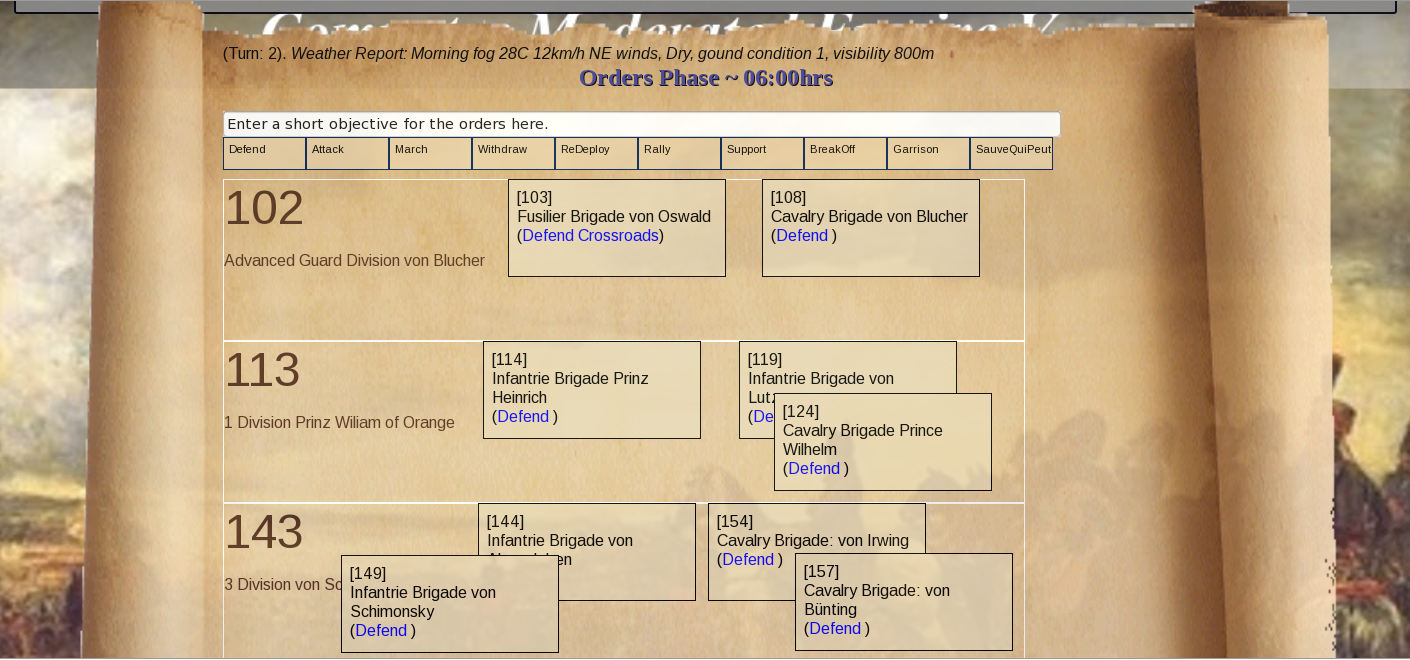
Each player communicates with his units through the orders screen.

In this example, there are several Divisions, each with a number of brigades. The player can drag the brigade boxes around to layout the formation of the whole Division.

This is important in Empire, as the manoeuvre elements require orders that specify the relative position of each manoeuvre element.

Orders can then be drag-and-dropped from the orders boxes onto the elements, depending on their type. (ie - support orders can only be dropped on cavalry brigades, garrison on infantry brigades, etc).  In each case, the description in the objective field (at the top of the screen) is applied to the order.

Placing an order on a unit creates an order dispatch for the unit, and the back end system delivers the order to the unit some time in the future, dependent on the distance to the recipient, and the professional skill rating of the staff for each unit.

The details of how the delay is calculated are faithful to the way that Empire V calculates it.

This also allows for the computer to model some personalities for non-player sub-commanders with a really simple AI system. A rash and impetuous computer controlled sub-commander may randomly misinterpret an order to defend as meaning 'Push forward and attack the enemy', for example.

Remote Wargaming :

Really looking forward to getting this part working. So far, there is no technical reason why the system wouldnt work out of the box with some players accessing the game remotely from the other side of the world.

You still need a real-life table setup with real people and all that, but it would be nice to have a mate from another country take command of a brigade in the game, and run it from over the internet.

Just need a decent webcam streaming thing (with audio support) to make that a reality.

Lets have a look at the Umpire view then ...

Note that the whole system is multi-user, so each user can be logged in at the same time, viewing their own data only, whilst the umpire is also logged in on another computer, controlling the flow of the game.

This is the administrator view of the user accounts.

In this case the Admin user has assigned the user account 'Augereau' to command the French VII Corps, and has assigned the user 'Duke of Brunswick' to command the opposing Prussians.

In addition to that, the user 'Wartensleben' has been assigned command of the Prussian 2nd Division.  When this user logs in, they will only be able to see the details of those units that are directly under their command (ie - 2nd Division forces)

This is interesting, since the user 'Duke of Brunswick' can see all of 2nd Divisions troops as well - as they are ultimately part of his wing, but he cannot issue orders to any units under 2nd Division. Only the delegate player 'Wartensleben' can do that.

The user 'Augereau' on the other hand gets to see and command all Divisions in his VII Corps, since he is the only user assigned to the French.

So the system allows multiple players per team to login to the system at the same time, and command a complex mix of delegation responsibilities.

Here is the Umpire / Admin view of the units involved in a game.

The Umpire gets to see a bit more detail on what is happening with each unit - note in this case that they can see accumulated actual casualties, as well as a detailed summary of actions in the previous turn which will have an effect on things like morale tests, and ME determination tests.

This is the main game control screen that the Umpire uses to run the game.

For each phase of a turn, this command console displays the details of what is happening in that phase, and provides the umpire with several buttons to control the flow of action.

In this case, it is simply the orders phase (Phase 1 in Empire), where users are given a couple of minutes to complete submitting their orders.

During orders phase, the umpire screen shows a clock counting up the seconds ... which changes from green, to blue, to finally red when 2 minutes has expired.

As players submit orders on their computers, the details of the orders automatically appear on this umpire screen (it polls the backend every 10 seconds to collect the latest orders).

This gives the umpire the opportunity to question any orders, or if they so choose, they can actually edit the order, add a delay to the order, or make the order dissapear. Its up to the umpire how they want to play that.

Once the umpire decides to close off the orders, they click the 'Close Orders' button. This advances the game to ME Determination phase.

After orders are closed, if any player submits a new order to the system, they get an immediate reply from their ADC telling them its too late :(

ME Determination Phase in the system.

The backend part of the system crunches through all the details for all units in the game, working out which units need to be checked .. digging up all the details, working out the % chances of failure, and then rolling the dice.

As you can see here, the report from the computer lays out all the steps that it takes to arrive at these results, including relevant die roll mods, etc.

This is still under Umpire control at this stage. If the Umpire decides that the result is not in the best interest of the game, for whatever reason, he can choose to 're-roll ME determination test' and get a completely fresh result.

Otherwise, click 'Accept ME Result' to apply the ME determination test and move on to the next phase. (ME Morale tests)

One thing I want to maybe add is an option to tell the computer that for a given game, player die rolls must be used instead of computer generated die rolls. In that case, the computer will add input boxes along the way to require the user to enter the value of the die rolls to be used in the calculations.

I think that option of allowing real-life die rolls to be used might be useful in any game, as it keeps the players 'involved' of you like, and kills any perception that the computer has taken the game over.

ME Determination results ... according to the rules, all ME determination results are to be made public to all players immediately. What I will do then is to create a dispatch message to all players if ANY unit from ANY side fails a determination test.

Other than that, any ME's that are becoming fragile through deteriorating morale or mounting losses, I am generating a dispatch message from the unit to the player, telling them in plain language that the unit is coming under some distress. (without the exact casualty details or % losses)..

The system, when its done, will be full of these little messages from the units arriving at the player's HQ.  The beauty of having the computer handle all of this communication is that it can correctly manage the delay.  For example, in the 3PM turn, the player may receive a message from a commander on a distant flank, who dispatched an urgent request for more ammunition at 1PM.

With the computer controlled sub-commander AI, dispatch reports from rash and impetuous sub commanders may be a little overly optimistic, whereas excessively cautious sub-commanders may exaggerate losses and the strength of enemy units. Lots of fun to be had with that, and great for Solo play as well.


Thats all for now ... back to coding. Hopefully will be able to report back with more updates soon.

Sunday, 8 April 2012

Campaign System Ideas - the Rule of 3

Thoughts of the Day


Some ideas here on extending the computer system to manage campaigns.

Handling the logistics and fog of war is one important aspect, and that is all covered quite well by best practices in this area.

Its the 'game' aspect that is a really hard call. A campaign that is done with full realism would tend towards becoming pretty dull pretty quickly, as a couple of decisive battles turn an even contest of a campaign into a simple mopping up and exploit operation. Not much fun in that.

Here are some psuedo-historical, but gamey ideas that might be worth playing with for a campaign system :


Tuesday, 3 April 2012

Computer Moderated Gaming - ORBAT editor all done !

Computer Hacks of the Day


Wow - that was  quick !

 The whole project is coming along quite nicely, but I figured that I dont want to get too bogged down in the force-editor part of the project if I can easily use something off the shelf.

Turns out there is an excellent utility program available that does a perfect job of editting ORBATs as portable XML files, and its free, and it runs on Windows and Linux as well. That part of the project is all done then.

I am using TreeLine to create and edit ORBATs then. It works brilliantly ! Its free for download, and runs on anything (Windows / Linux / Mac).

I have published some small sample ORBATs for download then ... please feel free to download any, have a play, and get back to me if you think it needs any changes.

http://15mm-madness.com/empire/OOB/

Also, feel free to email me any Orbats you come up with for inclusion in the list !!

Here is roughly how they look in the editor :

Sunday, 1 April 2012

Computer Moderated Gaming for Napoleonics. - Draft Specification


Computer Hacks of the Day
 

Here is a draft specification for something I am working on at the moment. Should keep me busy for a few months at least.

It is taking the bulk of Empire V rules, and using this as a specification for a computer moderated application to run Napoleonic Wargames.

I know that Carnage and Glory is out there, and it does a fantastic job of a difficult subject, but I am after something a little different.

ie :
  • I want to base it on deterministic rules that are well known / well understood. Empire V in this case. Might be a difficult set of rules for the average player to get their head around, but it provides a good basis for the computer to get it's head around.
  • I want something that is open source, so it can be hacked around with endlessly to add in house rules and things. Very important for me ... so that really rules out C&G for my use.
  • I want it to be able to run multi-user, so running it as a web application makes sense. Everyone just bring your laptop, and login to the server to play the game.
  • Being a web application, it would mean that a group of players who are remotely separated could all participate in a game. That is way outside the scope of this specification here, but at least the architecture of using a web server for driving the app leaves that path open for future development.
  • Ability for the application to display video clips / audio snippets as part of the user interface, to provide period chrome. Infantry volleys, cavalry charges ... whatever little video goodies you have on your hard disk should be able to be added in to the video library for the computer to add to the UI during phases of play.
  • I want full debugging details and audit trails for the 'admin user', but really sketchy fog-of-war details for the players. I even want the computer to deliberately make outright lies in it's status reports to players on occasion.

So - The Computer 'application' shall be written as an open source web application that runs on the LAMP stack, and allows for multiple simultaneous players to interact with it as the game is in progress, via a standard web browser.

Keep all the book keeping and calculations at the backend, and provide the players with a really flexible interface to  monitor what is going on, and to give orders to their units. 

Allow the computer to generate some advice to the players, acting as their logistics and operations staff officers.

Maybe later on - adding and AI to the backend for solo play. A lot harder than it sounds !

Keeping it simple, and keeping it open, I will use the following tech for getting this together :
  • Write the back end as a PHP application, using MySQL for data storage.
  • Use an off the shelf framework - probably codeigniter is a good choice. 
  • Distribute access to the code (as it is being developed) on a Git repository to allow for unlimited forking and distributed development.
  • Publish all work under appropriate licensing - LGPL, etc.
  • Maintain a public web page for users to download the latest release (for free).
  • Provide an online space for users to share electronic OOBs in a format that can be imported into the application.

Without further delay ... here is the high level spec document :


Friday, 30 March 2012

Grand Empire - Musketry and Artillery Tables

Rule Hacks of the Day

Following on from the previous post about scaling troop formations at 1:120 scale for Brigade / Regimental level , I thought I would have a hack around with the Empire V stats to see what I could come up with to produce a combat mechanism that works well at this scale.

Today I am looking at the effects of Firepower from massed musket volleys and batteries of cannon of various calibers. In this section, I am looking only at material losses and casualties caused by firepower. (Morale - I will look at later)


Back to the Future

First place to start is Empire V.

30+ years old already, but still one of the most detailed systems out there. Being a product of the 80's .. it has a real old school feel to it, which in this day and age tends to cop a lot of flack for some reason. Somewhat unfortunate I think, because it is not THAT hard at all.


Out of interest, there is still quite a solid community around this rule set, which given the age ... and the excellent new offerings in the same market, is quite remarkable. There is probably a good reason for that.

For those of you that dont yet know - Empire uses an amazingly detailed combat resolution system that involves quite a few calculations, LOTS of tables, LOTS of troop grades, and even pages of flowcharts to get you through small sections of the rules. If you like detail, you will love Empire.

For combat results from firepower - everything is worked out to the percentile, roll a few dice, lookup a few tables, and calculate the casualties from everything to artillery fire and musketry.

Casualties are then displayed as number of figures rendered ineffective.

First, a few GOOD things about this system :

  • The effects of firepower are deterministic. If you do the right thing and line up a decent attack, you will produce casualties.
  • You cannot get ridiculous results due to unusual die rolls.
  • The calculations are backed by a lot of serious period research.
  • The mechanics of the calculation .. whilst they do involve a lot of different tables, are actually pretty simple, clean and consistent.
For me, thats 4 really really really good reasons to have closer look at Empire.


"Modernizing" Empire

Now, there have many attempts to make use of this excellent source material in the Empire combat charts, and jazz it up with more modern gaming mechanics make it faster / more fun to play.

A lot of these have got the maths right up to point, by keeping the probabilities of the average results in line with  the Empire probabilities.

You can do this by substituting the fun 'bucket-o-dice' method with a probability curve where the peak sits inline with the peak of the original probability curve.

However - and this is a BIG however, the standard deviation of the probability curve on the bucket-o-dice method is wildly larger than the more deterministic approach used in the original Empire.  Makes for a good game, but its still not so good mathematically.

A little bit of spread is not a bad thing - those random outlier events do add some uncertainty to the game, which can add flavour when they happen at the right time. But its not that amusing when thousands of muskets roar at close range ... and some really odd dice rolls tell you that it had no appreciable effect. Thats not fun - even when it happens to the opponent.

So, I have put some effort in with these new tables to find a better balance between deterministic results and fun mechanisms .. whilst keeping the maths more inline with the original.


Summary of The Approach

A quick summary of the things that I am trying to do with this are :

  1. REDUCE table lookups and calculations to a minimum. I get enough of that at work ... gaming time should be fun.
  2. ADD some gaming chrome.
  3. ADD some fog of war. 
  4. Make some minor adjustments applicable to brigade / regimental level gaming.

Approach taken :

Reducing table lookups is simple enough. A combination of dice and rules of thumb provide well tested mechanisms. You find this approach being used in a lot of systems that are popular at the moment.

Just have to be careful with the maths and that whole standard deviation issue.

One thing that I find hurts my brain during a game is die roll modifiers. I hate them !!  Just having to add +1 here, and -2 there may be simple enough, but I find that it requires that you set aside some of your short term memory to perform these calculations.  Dont like !


Fog of War / Brigade level adjustments.

One thing with Empire is that you tend to play the game at both Corps/Army command level as one game, and Divisional/Brigade commander at another. Its almost like 2 games in one - and that sits well when you have lots of players in the game.

Because of this, there is a lot of detail at the battalion level (number of casualties for example), that an officer at the Corps level would really have no way of knowing during the battle.

To translate a game up to brigade level, where you are just a Corps commander only, it is best to hide some of the detail happening down the line.

Ive taken a Schroedinger's Cat approach to this, and defined 'Casualties' as something a little more rubbery. Its a mechanism that comes out of KISS Rommel - WW2 operational scale rules, that is so simple and yet so coincidentally accurate.

When a 'base' of figures gets to half strength, its considered 'killed'. But 'killed' bases can be randomly recovered during the game. In a WW2 context, this is modeled as a whole battalion vanishing off the map as it is dispersed. It may re-appear on a good roll of the dice, or it may be lost for good. As Corps commander, you don't know the full details until after the event,

So I like that mechanism enough that I think I will use it for naps as well.


Figure Scaling Effects

The default scaling in Empire is :
1" on the table = 40 yards, and 1:60 for the figure scale.

For whatever reason, I will be playing at 1:120 scale, which is half that of the default. I have taken that into account with the tables generated below.


Using a figure scale of 1:120, and a ground scale of 1" = 120 paces  (distance that troops march in 1 minute at quick time pace in perfect conditions), which provides a convenient mapping scale of 1' on the table = (almost exactly) 1km in real life. Nice !

With a figure scale of 1:120, that gives me little bases of 3 figures, representing 360 troops in 3 ranks on a 30x20mm base.  (120 men per rank on a frontage of around 120 paces).  2 of these bases make up a French Battalion at full strength for example.

A visual description of battalions of 3 rank troops in a variety of formations on the table top.


For troops in 2 ranks, I will be using   2 figures on a 1" x 0.5" base representing 240 men.  I kind of like the quirky idea of having the continental troops based on the metric system and the Brits on imperial system bases.

Crazy perhaps ... but it makes sense to me in a perverse way.

So now, after having crunched the numbers with all the various casualty charts, which depend on a number of factors such as :
  • The troop grade of the firer
  • The number of ranks firing (3 vs 2)
  • The range of the shot.
  • The formation of the target unit (Column/Line/Square/OpenOrder/Skirmish/ClosedColumn)
  • The cover of the target unit.
I have come up with a single table that takes all of the above into account, and then expanded the probabilities out to work for my 3 figure troop bases above.

Also works for my 2 figure British bases ... since in both cases, a 'Base' of troops at full strength is always 120 muskets bringing fire to bare.


Representing Casualties - Whats in a Kill ?

I will cover this question now, before looking at the charts, so at least it is explained what is meant by a 'KILL' before you read the casualty charts.

In vanilla Empire, with a figure scale of 1:60, each KILL represents 1 casting to be removed from play.

So thats 60 troops taken out of the battle - either dead, wounded, disheartened, or whatever.

At 1:120 scale, each of my figures represents '2 castings' in Empire terms at 1:60 scale.

So a base of standard line infantry in 3 ranks needs the equivalent of 6 KILLs to wipe them out.

That presents the possibility of a quite a bit of bookkeeping. Don't like bookkeeping !

So I am defining KILL as meaning this, at this scale of the game :

  • Each KILL means that 10 troops are actually killed, 20 are actually wounded, and the other 90 that make up the casting are in various states of distress. They could even be out of action due to helping the wounded.
  • A line of troops in 3 ranks can take more damage than a line of troops in 2 ranks ... since as men drop to the ground in the front, others push forward from behind to take their place.
  • Therefore, a KILL represents a good portion of a rank from 1 casting pretty much out of action for one reason or another. 
  • A UNIT of troops in 3 ranks can handle having 3 KILLs and still perform effectively. When it takes the 4th hit, 1 BASE is removed from the unit.
  • A UNIT of troops in 2 ranks can handle having 2 KILLs and still perform effectively. When it takes the 3rd hit, 1 BASE is removed from the unit.
At the Corps commander level,  these 'LOST BASES'  are known to be out of action, but you dont know the full extent of the damage. Each hourly round, the player(s) can take actions to recover troops from these lost bases, and possibly get them back into action.

Hence the Schroedinger's cat quantum thing - you don't know whether the cat is dead or alive until you look in the box .. so until that happens, the cat is considered somewhere in limbo.


Musketry Fire


Musketry fire involves any small arms fire from any large group of weapons, at ranges from out to 300 paces, down to 50 paces.

This includes battalions of infantry firing volleys at the enemy. This can also include volley fire from the light infantry formed up in closed ranks  .. and it can also include prepared volley fire from cavalry armed with carbines at close enough range.

This method also applies to masses of unformed troops firing aimed shots in open order (eg - 1813+ Prussian musketeers in open order).

For units firing in Skirmish order ... that is  treated differently. See the section on Skirmish Fire below.

'Volley Fire' in this sense means a number of volleys fired during a short period of a minute or 2.

If a unit does very well, it may unleash 3 rounds a minute of solid aimed fire with great discipline.

On the other hand, a unit may start off with a decent enough volley, before panic sets in and shots become sporadic.

What we are looking for here is the overall performance of the unit in a short but sharp period of firing.


Procedure :

For each unit firing a volley as a group, run through the following steps :
  1. Roll 2 firing dice for the whole volley.
  2. The TYPE of dice used depend on the Firing Class of the unit.
  3. Check the pair of dice, and determine from that what the overall performance of the unit was.
  4. Make any adjustments according to the sitations below.
  5. Now lookup the table, cross referencing the number of bases firing with the overall performance of the volleys.  This is the number of KILLS.
  6. Now apply some extra D6 rolls if there are any special circumstances, as listed below.
    If the firer is of varied types, then either average the class, or resolve separate attacks .. up to you.

    Note that some very poor  units (militia, etc) only get 1 firing dice.

    Note - that as in the real Empire rules, a unit's Firepower skill follows that unit's rating. Old Guard shoot as Old Guard,  Grenadiers shoot as Grenadiers, etc.

    Some units have a different firepower skill to their general morale grade. For example, Russian veteran line might be classed as Conscript line for fire results, but fight defensively as Crack Line.

    Whatever works for you ...

    Another method that could be used is to use consistent morale grades for firing, but DROP the calculated "Overall Unit Performance" level down a grade if that force is known to have exceptionally bad muskets, a shocking supply of gunpowder ... a shocking epidemic of dysentery in the ranks ... or whatever situation the campaign calls for.

    Something to play with anyway.


    Firing Dice Used :


    Firing Unit Troop GradeDice 1Dice 2
    Old GuardD12D10
    GuardsD10D10
    GrenadiersD10D8
    ElitesD8D8
    Crack LineD8D6
    Veteran LineD6D6
    Conscript LineD6D4
    LandwehrD4D4
    Trained MilitiaD6NONE
    Untrained MilitiaD4NONE


    Firing Unit Overall Performance :

    If BOTH dice are 8+The unit has fired a SUPERB series of excellent Volleys
    if BOTH dice are 6+ The unit has demonstrated a SPLENDID display of musketry
    if BOTH dice are 4+ The unit has got off a number of FINE volleys
    if ONLY ONE dice is 4+A REASONABLE effort - at least one decent volley has been fired
    if NONE are 4+ A poor showing, one half decent volley and SPORADIC fire
    if NONE are 6+ and ANY roll a 1 Some misfires and sporadic panic shots - a PITIFUL effort
    if BOTH are natural 1'sAn ABSOLUTE DISGRACE !

    Adjustments :
    • Firing unit in open order - drop result DOWN 1 level.
    • Firing unit is shaken - drop result DOWN 2 levels
    • Firing unit is broken - drop result DOWN 3 levels


    In the case of Militia firing with a single D6, a '1' results in an absolute disgrace, 2 for a Pitiful effort, 3-5 for a poor showing, and 6 for a reasonable volley.

    In the case of Untrained Militia ... a single D4 with :
    1. An Absolute Disgrace
    2. A Pitiful Effort
    3. Sporadic shooting
    4. A Reasonable effort.
    Old Guard can also put in an Absolute Disgrace ... but the chances are less than 1%. They are more than 50% likely to put in at least a Splendid display of shooting.

    Landwehr are interesting. They will usually put in poor showing most of the time, getting in a half a proper volley before firing sporadically at will. On some rare occasions though (1 in 16 chance), they will hold it all together and put in a series of fine volleys .. as good as any Veteran line unit would be expected to perform.


    Firing Unit Performance vs Bases Firing = Number of KILLS


    Musketry Bases (6 castings equiv) Firing vs LINE


    1 2 3 4 5 6 7 8 9 10 11 12
    Superb !!

    2 3 5 6 7 9 10 12 13 15 16 18
    Splendid !

    1 2 3 4 5 6 7 9 10 11 12 13
    Fine shot

    1 2 3 3 4 5 6 7 8 8 9 10
    Reasonable
    1 1 2 2 3 4 4 5 5 6 7 7
    Sporadic
    0 1 1 1 2 2 3 3 3 4 4 4
    Pitiful 0 0 1 1 1 1 1 2 2 2 2 2
    Disgraceful
    0 0 0 0 1 1 1 1 1 1 1 2


    Range Effects on Musketry :


    Range Effects
    0-1" -2" -3" -4"


    Muskets


    N/A


    Steady, aimed fire from Rifles. Can roll any 1 dice again.
    Sharpshooters


    Use chart above.


    Rifles


    D6 for each kill 4+ = save


    D6 for each kill 3+= save


    Grrrr .. blogger can be a pain to get formatting of tables right sometimes !!

    What the above means, in plain English - is that KILLs from muskets have no save at up to 1",   a 50% save up to 2" and a 66% save up to 3".

    Sharpshooters do a little better at longer ranges, as do Rifles.

    Rifles get a slight bonus at ranges between 120-240 paces, as they can spend a little more time at that range on getting the breathing right and landing a good shot, as they are trained to do.


    Fine Tuning the results for special situations (D6 per kill) :
    • Target in Square or Column:   5+ = extra kill.
    • Target in Open Order.:  6 = Save
    • Target is in Skirmish Order: 5+ = saved.
    • Target in Cover: 4+ Heavy, 5+ Medium, 6 Light = save.

    .... and thats it for musketry  !


    .... almost !

    Firefight Resolution Shortcut :

    Empire V provides a fairly comprehensive firefight resolution system that measures what happens when 2 units fight it out with volleys. This result is in addition to any losses from the shooting itself.

    This can get a little involved at times, depending on the situation. Here is a quick shortcut that gets straight to the point :


    Whichever side scored the best Overall Performance Result in the musketry round above .. declare them the winner, and roll for the firefight result on Table 2.

    If its too close to call, or the 'loser' has some significant advantage such as being in cover, or has a leader attached ... or if there is any doubt at all who the winner clearly is - then roll on Table 1.

    Easy !


    Artillery Fire :

    Same trick with artillery here.

    1 model gun at this scale represents a half-battery of 6 guns, spread out about 20 paces per gun.

    Procedure :
    1. Measure the range (in inches)
    2. Count the number of gun models firing.
    3. Cross reference to determine the number of KILLS.
    Each whole number on the chart = 1 kill.
    Each fractional number on the chart = probability of another kill.

    e.g.  1.7 kills = 1 definite kill, and a 70% chance of a second.

    70% can be translated as 'Roll D10  <= 7'.


    Firer Class Adjustments :
    • French Old Guard :  ALWAYS round up to the next whole number. So 2.0 on the table = 2 kills, but 2.1 kills on the table = 3 kills.  
    • 1st Class batteries. If fraction die fails to score an extra kill, but is EVEN, then its still a kill after all.
    • 2nd Class batteries.  No change.
    • 3rd Class batteries. If fraction die gains an extra kill, but is ODD, then it is not a kill after all.
    Artillery Table :


    Light Cannon

    Medium Cannon

    Heavy Cannon


    1 2 3 4 1 2 3 4 1 2 3 4
    Range 1" 0.7 1.4 2.1 2.8 0.9 1.8 2.7 3.6 1.2 2.4 3.6 4.8
    to 3" 0.4 0.8 1.3 1.7 0.5 1.1 1.6 2.2 0.9 1.8 2.7 3.6
    Target 5" 0.4 0.7 1.1 1.4 0.4 0.8 1.3 1.7 0.6 1.2 1.8 2.4

    8" 0.2 0.4 0.5 0.7 0.3 0.6 0.9 1.2 0.4 0.8 1.2 1.6

    12" 0.1 0.1 0.2 0.2 0.1 0.2 0.4 0.5 0.2 0.4 0.6 0.8

    18"


    0.1 0.1 0.2 0.2 0.2 0.3 0.5 0.6

    24"


    0.1 0.2 0.2 0.3

    Fine Tuning the results for Special Situations (D6 for each kill)
    • vs Square: 4+ = extra kill.
    • vs Column: 6 = extra kill for 2nd rank. 5 = extra kill if more than 2 ranks of bases in the column.
    • vs Open Order.: 5+ = saved
    • vs Skirmish Order: 4+ = saved.
    • vs Cover. 3+ Heavy Cover, 4+ Medium Cover, 6+ Light Cover.
    Skirmish Fire :

    Representing skirmish capability can be a bit of a nightmare.

    To do it 'properly', you probably need to break down the types of skirmishers into several different classes, and give them all different probabilities of causing some sort of damage to the enemy.

    Thats all well and good until you actually calculate all those factors, roll the dice, and then 90% of the time find that the result of skirmish fire is pretty much negligible in the big picture of the whole battle.

    Not that I want to skimp on detail, but I just feel that detailed modelling of skirmish fire is a low  return on investment in a brigade scale game.

    So - Stick to the way that Republique handles skirmishing very nicely.

    Real Simple Skirmish Rules :

    • Each UNIT with no serious skirmish doctrine ... gets 0 skirmishers.
    • Each BATTALION of an army with Semi-Skirmish capability can put out 1 skirmisher per battalion.
    • Each BASE of a unit of trained light infantry can put out 1 skirmisher per base.
    • Each FIGURE of a unit of elite light infantry (95th rifles, etc) can put out 1 skirmisher per figure.  (2 per base)

    Skirmisher combat :
    • All skirmisher fire is effective out to 4"
    • Count up the total number of skirmishers in a contested firefight on both sides. Skirmishers from opposing sides cancel each other out, so one side should have an 'overlap' of skirmishers to shoot at the main body of troops.
    •  Roll D10 for each skirmisher in the overlap.  Natural 0 = 1 KILL.

    For UNIT who fight in close combat who are unlucky enough to still have some of their companies deployed out of the line as skirmishers  .... -1 on the dreaded ACE table for EACH skirmisher still deployed.

    So - if a French Legere regiment of 6 bases has all 6 skirmishers out and it gets hit by enemy cavalry .... its a -6 on the ACE computer,  which represents the fact that the unit as a whole is in big trouble !!


    Thats all for now.

    If the above ideas appeal in any way, I hope you get a chance to playtest some of those ideas in a brigade scale game.

    I would be very keen to hear any feedback.

    Aside from the charts above, just use standard Empire for the rest of the actions in the game ... which I am finding that despite the perceived 'bulk' of the rulebook, its really quite a sensible system with fast common sense rules that have a good period feel to them.

    Next article - I will have a look at the dreaded issue of modelling Morale.

    So far, I don't see any huge clunkuness or other problems with the way that Empire tracks morale. Might just need to make a few minor tweaks to accomodate the different scaling, and attach some sort of meaning to the use of the Sabot bases.